

You have the job offer, the start date is fixed, and every rental listing seems to be gone before you can reply. Most relocation guides push you to sign a twelve-month lease before you have even packed a bag. That approach often leads to expensive regrets. A staged plan, using temporary housing in Bicester first and a long-term rental later, gives you time to learn the town and choose a home you actually want to live in.
This guide walks you through that plan step by step: what temporary accommodation costs in time and logistics, how to shortlist neighbourhoods once you are local, and the mistakes that catch out relocators who try to do everything in one weekend.
Temporary housing in Bicester: the quick answer
- Best for: anyone starting a new role within four to six weeks, or relocating without a chance to view rentals in person.
- Best timing: book temporary accommodation as soon as your start date is confirmed, ideally four to eight weeks ahead.
- Typical options: serviced apartments, house shares with flexible terms, and short-term lets arranged through local letting agents.
- Quick logistics: Bicester has two railway stations, Bicester North (Chiltern line to London Marylebone) and Bicester Village (Oxford Parkway and Oxford), so a temporary base near either keeps commuting simple.
- Who it suits: remote workers and hybrid professionals who need reliable broadband and a calm workspace more than a long lease.
Why staging your move beats one-shot rental hunting
Rushing straight into a twelve-month lease is the single most common relocation mistake, and it is an expensive one to undo.
When you rent from a distance, you are choosing from listings, photos and a fifteen-minute video call. You cannot tell whether the street is quiet at 11pm, whether the walk to the station is pleasant in the rain, or whether the flat next door has thin walls. A short temporary stay converts those unknowns into things you can check yourself.
There is a financial argument too. Breaking a tenancy early usually means paying until a replacement tenant is found, plus re-letting fees. A few weeks in temporary housing costs less than an early exit from the wrong lease.
What staged relocation actually looks like
- Weeks 1–2: confirm your start date, book temporary accommodation, and set a realistic monthly rent budget including bills.
- Weeks 3–4: move into your temporary base. Spend evenings and weekends walking neighbourhoods rather than scrolling listings.
- Weeks 5–8: view rentals in person, shortlist two or three, and start referencing early. Have your documents ready before you view.
- Weeks 9–12: sign the long-term lease and move your belongings once, into the right place.
Choosing your temporary base: what to weigh up
Pick your temporary housing for logistics first and comfort second, because you will only be there for a matter of weeks.
Budget and bills
Serviced apartments bundle utilities, Wi-Fi and often cleaning into one figure, which makes short stays easier to budget. House shares with flexible terms usually cost less per week but come with shared kitchens and less certainty about housemates. Ask directly what is included before you commit, and check whether a deposit is required and how it is protected.
Transport and commuting
If you will be commuting to Oxford, London or Bicester’s employment areas, prioritise a base within walking distance of Bicester North or Bicester Village station. If you drive, check parking before you book. Many town-centre flats do not include a space, and on-street permits have waiting lists.
Workspace and connectivity
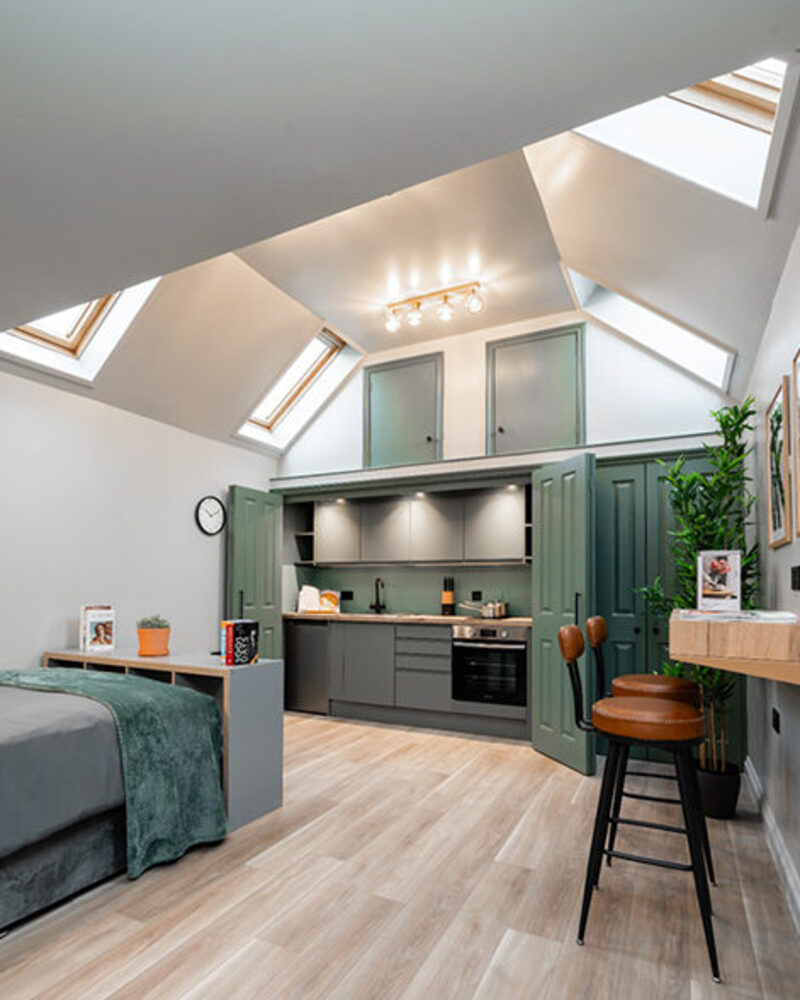
For remote workers, this matters more than square footage. Ask for the actual broadband speed rather than a vague promise of “fast Wi-Fi”, and confirm there is a desk and a door you can close for calls. If you take video meetings daily, a studio with a separate kitchen area usually works better than a room in a shared house.
Where to look once you are ready for a long-term rental
Bicester is compact, so most neighbourhoods are within a short cycle or bus ride of the centre. The differences are in feel, housing stock and commute convenience.

Town centre and around Sheep Street
Best for walkability. You are close to shops, cafes and both stations, which suits professionals who want to leave the car behind. Insider tip: check parking arrangements before viewing anything central, because spaces are the first thing to disappear in a listing.
Bicester Village and the south side
Convenient for the Bicester Village station and the retail quarter, with a steady supply of newer apartments. Insider tip: the area is busiest at weekends, so visit on a Saturday before you decide, not just on a quiet Tuesday evening.
Bure Park, Langford Village and Kingsmere
Popular with families and professionals who want quieter streets, green space and easy parking. Kingsmere in particular has a mix of newer homes and a village feel. Insider tip: these areas are less walkable to the stations, so factor in a bike, bus or car from day one.
Villages just outside town
Places like Chesterton, Launton and Caversfield offer more space for the money and quick access to the M40. Insider tip: bus frequencies drop in the evenings, so test the journey at the time you would actually be travelling.
How to choose between two good rentals
When you are torn, score each option against the same four criteria rather than going on gut feel.
- Budget: total monthly cost including council tax band, energy estimates and any parking permit.
- Vibe: visit at different times of day and on a weekend. Noise, footfall and light change dramatically.
- Timing: how soon can you move in, and does the tenancy length match how long you expect to stay?
- Transport: door-to-platform time, not just distance on a map.

At a glance: your first two weeks in Bicester
- Day 1–2: unpack, set up your workspace, test the broadband on a real call.
- Day 3: walk the town centre and get a feel for Sheep Street and the market area.
- Day 4–5: ride or drive the commute route at the exact time you would normally travel.
- Weekend 1: visit two or three shortlisted neighbourhoods on foot, including one in the evening.
- Week 2: register with a GP, sort your council tax, and book your first rental viewings.
Local logistics: getting around and booking ahead
Bicester sits between Oxford and Milton Keynes, with the M40 close by and regular trains to both London Marylebone and Oxford. For most relocators, a car is not essential in the town centre but becomes useful for village life and weekend trips.
Book temporary accommodation early, especially in the run-up to the Christmas shopping period and during university term start in Oxford, when demand for short lets rises. Ask about minimum stay lengths, notice periods and whether the rate changes for longer bookings.
If you have accessibility needs, confirm step-free access, lift availability and bathroom layout directly with the host or agent. Listings often omit these details, and it is far easier to ask before booking than to move twice.
Common mistakes to avoid
- Signing a twelve-month lease from a video tour. You cannot assess noise, damp or neighbours through a screen. Use temporary housing to view in person.
- Ignoring the total cost of a rental. Council tax band, energy performance and parking permits can swing your monthly outgoings significantly. Ask for the EPC rating before you commit.
- Leaving referencing until after you have found the place. Have ID, proof of address, employment details and references ready so you can move quickly when the right home appears.
Frequently asked questions
How long should I stay in temporary housing before renting long term?
Four to eight weeks works well for most people. It gives you enough time to view rentals in person, understand the neighbourhoods and complete referencing without pressure.
Is temporary housing in Bicester expensive compared with a normal rental?
Serviced apartments usually cost more per week than a standard long-term let, but they include bills and flexibility. Treat the difference as the price of avoiding a costly early exit from the wrong tenancy.
Do I need a car to live in Bicester?
Not if you are based near the town centre or either railway station. If you are considering villages such as Chesterton or Launton, a car or bike makes daily life considerably easier.
What should remote workers check before booking temporary accommodation?
Confirm the actual broadband speed, that there is a proper desk, and whether calls are practical from the room. Ask about mobile signal indoors too, as coverage varies between buildings.
When is the best time to look for a long-term rental in Bicester?
Spring and late summer tend to bring more listings, while the run-up to Christmas is quieter. Whatever the season, start viewings as soon as you are local rather than waiting for a perfect moment.
Living well in Bicester, one step at a time
Relocating is easier when you stop treating it as a single decision. A short stay in temporary housing buys you the time to learn how Bicester actually feels day to day, from the walk to the station to which cafe you will end up in every Saturday. That local knowledge turns a rushed rental choice into a confident one, and it is the difference between a house you tolerate and a home you settle into.
If you are planning a move to Bicester or Oxford and want a base that makes the transition straightforward, B-Hive Living builds flexible, well-connected homes for professionals and remote workers. We would be glad to talk through what is available and help you plan your first few months. Get in touch to start your application.
